

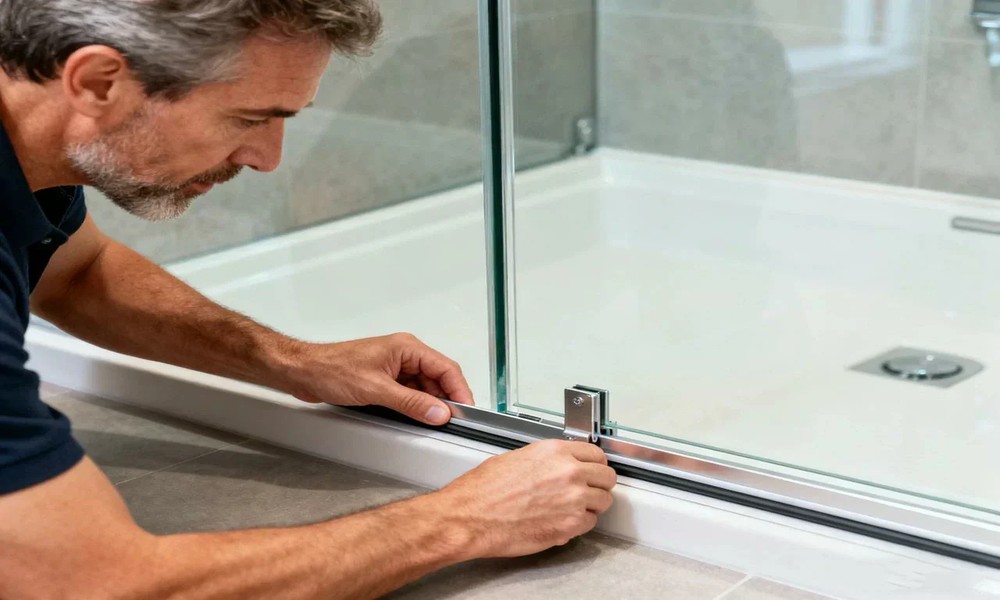
There is a very specific sound patio doors make right before homeowners decide to “have a go themselves”.
A rough scraping noise.
Usually followed by a sigh.
Then somebody disappears into the garage looking for WD40 and a screwdriver.
You see it constantly across West Yorkshire. Leeds especially. People notice their sliding patio door has become stiff during damp weather, watch a quick online video, spray half a can of lubricant into the track and convince themselves they have solved it.
For about three days.
Then the door gets worse.
A lot worse sometimes.
The strange thing is most people are not being reckless. They are just trying to avoid what they assume will become a huge repair bill. Particularly now, when households are already juggling enough expenses as it is.
But patio door systems are one of those things where small mistakes tend to create larger mechanical problems surprisingly quickly.
And this year has been bad for it.
The amount of DIY damage appearing alongside genuine wear-and-tear is noticeably increasing. Particularly after months of damp Yorkshire weather causing more sliding and bifold systems to become sluggish in the first place.
One of the busiest areas lately for patio door repair services has not actually been failed doors. It has been doors that were still repairable until somebody tried forcing an adjustment they did not fully understand.
That sounds harsher than intended.
But it keeps happening.
WD40 Is Not The Miracle Cure People Think It Is
This probably annoys some people because WD40 has become the universal household “fix everything” spray.
Stiff hinge? WD40.
Squeaky lock? WD40.
Patio door dragging? Apparently also WD40.
The problem is sliding door tracks are not simple hinges.
Tracks collect grit constantly. Tiny stones, dust, pet hair, soil from gardens, bits of leaves, dried mud. Once you spray oily lubricant heavily across contaminated tracks, you basically create grinding paste.
Then rollers start dragging through it daily.
You can usually tell immediately when somebody has done this because the track develops thick black sludge around the runners. Everything feels heavier and rougher than before.
One contractor around Wakefield described it as “turning the track into sandpaper”.
Fair description honestly.
A lot of homeowners think lubrication fixes stiffness when often the underlying issue is worn rollers, poor alignment or track contamination instead.
The lubricant just temporarily masks the symptom.
Then the real damage continues underneath.
The Internet Makes Door Repairs Look Simpler Than They Are
This is part of the problem now.
Online videos compress repairs into neat five-minute demonstrations that make complex adjustments look easy. The reality inside actual West Yorkshire homes tends to be far messier.
A bifold door that has dropped slightly might appear straightforward until you realise the frame itself has shifted marginally over time.
A sliding patio door might look misaligned when actually the rollers internally are collapsing.
A stiff lock might not need force at all. It might need precise realignment by a couple of millimetres.
People underestimate how interconnected modern door systems are mechanically.
Adjust one thing incorrectly and another problem appears somewhere else.
One thing I see often is homeowners attempting to raise dropped patio doors by aggressively adjusting roller screws without understanding the weight distribution across the system.
Sometimes they overcompensate so heavily the locking strip no longer aligns at all afterwards.
Then what started as slight stiffness becomes a door that physically will not lock.
Yorkshire Weather Has Made Everything Worse This Year
The damp weather has definitely accelerated the number of repair issues appearing across Leeds, Bradford and the surrounding towns lately.
Doors that were already marginal mechanically have started struggling badly.
Especially older UPVC sliders.
Cold mornings followed by warmer afternoons create expansion movement constantly through spring and early summer. Older rollers and locking systems do not always cope well once wear begins setting in.
Then homeowners force the handle harder because the door suddenly feels tighter than usual.
That repeated force damages components surprisingly quickly.
A lot of people assume patio doors are robust because they feel heavy and solid. Mechanically though, many systems rely on fairly precise tolerances internally. Once alignment drifts slightly, wear accelerates.
Particularly around the locking points.
One thing you hear repeatedly now is:
“It was only catching occasionally before.”
That “occasionally” part matters.
Doors nearly always give warning signs before bigger failures happen.
The Worst DIY Fixes Tend To Be Creative
There is almost an art form developing around temporary patio door fixes lately.
Bits of cardboard stuffed under rollers.
Sealant squeezed into tracks.
Packing pieces jammed into locking keeps.
Tape wrapped around loose handles.
One homeowner in Featherstone had actually hammered thin coins underneath a dropped track trying to level the door slightly.
Ingenious in a strange way.
Absolutely catastrophic mechanically.
Another in Pontefract had sprayed expanding foam around a loose patio frame because somebody online apparently claimed it would “stabilise movement”.
It did not stabilise anything. It just made later repair work far more awkward.
People are improvising because they want to avoid major replacement costs.
Completely understandable.
But patio and bifold systems are not forgiving once adjustments go wrong.
Sliding Doors Quietly Deteriorate For Years
That is part of the issue.
Most patio doors fail slowly enough that homeowners adapt around the deterioration rather than dealing with it early.
The handle gets slightly stiffer.
The rollers become noisier.
The lock occasionally catches.
People gradually change how they use the door without fully noticing.
Then eventually somebody visits the house and immediately says, “that door shouldn’t feel like that”.
You see it constantly around older properties in Wakefield and Castleford where patio systems fitted fifteen or twenty years ago are now entering the stage where multiple components begin ageing together.
Tracks wear unevenly.
Rollers flatten internally.
Locking strips drift out slightly.
Drainage channels block over time too, which many homeowners never even realise exist.
Then after years of gradual deterioration, somebody watches an online repair video and unintentionally finishes the system off completely.
Bifold Doors Are Creating Different Problems
Bifold systems have their own category of DIY disasters.
Mostly because homeowners assume visible adjustment screws automatically mean “easy adjustment”.
Not really.
A dropped bifold panel often affects several other alignment points across the system simultaneously. Lifting one corner without understanding hinge pressure or roller positioning can throw the entire opening sequence out.
This is becoming more common across newer extension-heavy areas around Leeds and Wetherby where bifold installations exploded over the last decade.
A lot of homeowners were sold these huge opening systems as almost maintenance-free lifestyle upgrades.
Nobody really explained the mechanical reality properly.
Tracks need cleaning.
Rollers wear.
Alignment drifts.
Houses settle slightly.
And once bifolds begin dragging, repeated forcing tends to damage hinges faster than people expect.
This spring alone there have been huge numbers of bifold door repair callouts where the original issue was relatively minor until repeated DIY adjustments complicated things further.
That is the frustrating part.
Many repairs genuinely are straightforward early on.
The Cost Fear Is Driving A Lot Of This
You can understand why people delay repairs or attempt fixes themselves now.
Everything feels expensive.
A lot of homeowners hear “bifold door problem” and immediately assume they are about to face replacement quotes running into thousands. Particularly with large aluminium systems.
So they keep forcing the door a little longer.
Or attempt small repairs themselves hoping to buy time.
Sometimes they succeed briefly.
Usually the problem quietly worsens underneath.
One thing that has changed across West Yorkshire recently is the number of homeowners specifically asking whether mechanisms can be repaired rather than replaced entirely.
Five years ago people often jumped straight toward replacement discussions. Now there is far more focus on targeted repairs instead.
Particularly for sliding systems.
That shift makes sense financially because many doors still have perfectly good frames and glazing. The actual failure is often mechanical rather than structural.
Things like worn rollers, damaged handles, failed locks or alignment drift.
That is why proper UPVC mechanism repairs are becoming much more common now rather than full replacements.
Cheap Installations Are Catching Up With People
There is another awkward truth underneath some of these repair issues.
Not every patio or bifold installation was done particularly well originally.
Some systems were fitted during huge extension booms where speed mattered more than long-term precision. Especially across Leeds suburbs where rear kitchen extensions became massively popular during the late 2000s and early 2010s.
You can often tell when installation tolerances were rushed.
Doors become sensitive to seasonal movement far earlier.
Alignment drifts more aggressively.
Tracks wear unevenly.
Rollers carry load badly.
Then homeowners assume the product itself is faulty when really the original installation created underlying weaknesses from day one.
And once weather starts affecting those weaknesses repeatedly, DIY adjustments rarely solve the real issue.
They usually just move the problem elsewhere temporarily.
Some Problems Look Worse Than They Are
This is where people sometimes panic unnecessarily.
Not every stiff patio door means replacement.
Not every dropped bifold means catastrophic failure.
A lot of systems simply need proper adjustment and worn hardware replacing before secondary damage develops.
Especially UPVC sliding doors.
Many older systems around Leeds and Bradford still have years of life left mechanically if dealt with early enough.
But timing matters.
One thing I see often is homeowners tolerating issues for so long that multiple components wear together. A damaged roller then affects the track. Misalignment damages the locking points. Excessive force affects handles and keeps.
That is when repair costs rise sharply.
The expensive repairs usually started as fairly small issues months or years earlier.
The “It Still Opens” Mentality Causes Problems
This might be the biggest issue of all.
People judge doors by whether they technically still function.
If the patio door eventually opens, they keep using it.
If the bifold eventually locks after lifting the handle hard enough, they assume it is manageable.
But these systems nearly always deteriorate progressively once wear begins.
Dragging becomes grinding.
Catching becomes misalignment.
Stiffness becomes failed locking.
The warning signs are usually there long before complete failure happens.
And after the wet weather Yorkshire has had recently, weak systems are being exposed much faster than normal.
Particularly older sliding doors.
Most Homeowners Only Want The Door To Feel Normal Again
That is the funny thing about all this.
People are not expecting perfection.
They just want the door to stop fighting them every morning.
They want it to slide properly without needing shoulder pressure. They want the lock to engage smoothly again. They want condensation and draughts reduced before winter comes back around.
Normal operation basically.
A properly functioning patio door should feel effortless compared to many of the struggling systems currently being forced open daily around West Yorkshire.
And most of the worst repair jobs started exactly the same way.
A slightly stiff door.
A quick online fix.
Then a much bigger problem a few weeks later.