

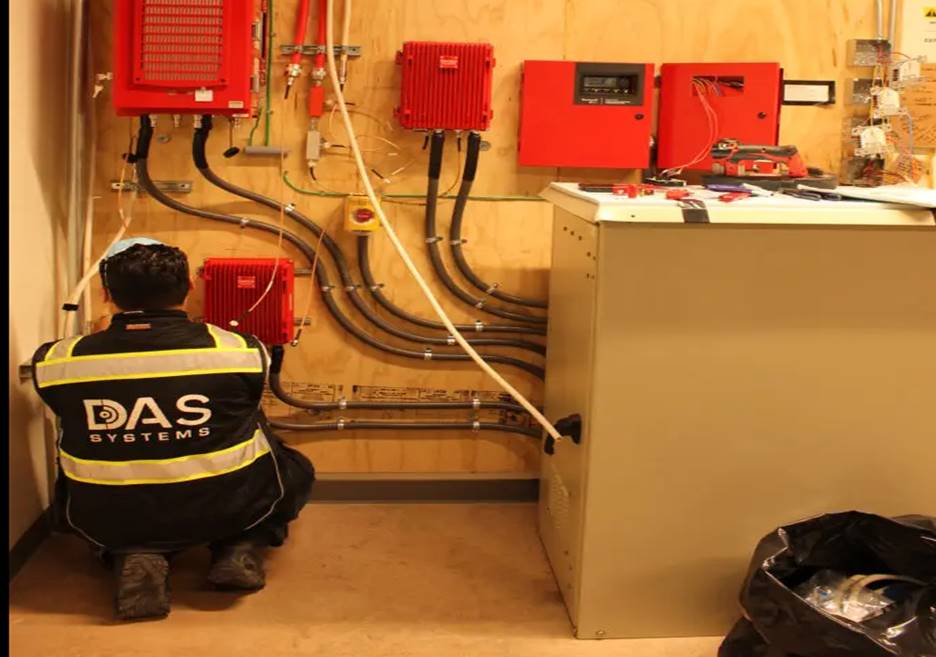
In any emergency, reliable communication is essential for first responders. Large buildings—such as high-rises, campuses, and underground facilities—often have materials like concrete, steel, or low-emissivity glass that block or weaken radio signals. Bi-Directional Amplifier (BDA) systems are designed to solve this problem, ensuring that public safety communication remains uninterrupted when it matters most.
BDAs are a critical part of Emergency Responder Communication Enhancement Systems (ERCES) and help buildings comply with NFPA 72 and IFC codes. Beyond compliance, they provide life-saving functionality by guaranteeing clear communication for fire, police, and medical personnel.
What Is a BDA System and How Does It Work?
A Bi-Directional Amplifier is a signal-boosting device that enhances two-way radio communication by amplifying both uplink (inside-to-outside) and downlink (outside-to-inside) signals. BDAs are used in buildings where radio signals struggle to penetrate due to dense construction materials, complex layouts, or large size.
BDAs often work in conjunction with Distributed Antenna Systems (DAS) to provide comprehensive in-building coverage. By combining these systems, buildings can ensure reliable communication in all areas, from stairwells and basements to upper floors and large atriums.
Problems BDAs Solve
BDAs address several common communication challenges in large buildings:
- Dead Zones: Eliminates areas with weak or no signal, such as basements, elevator shafts, and parking garages.
- Signal Dropouts: Prevents inconsistent communication in buildings with dense materials like metal and concrete.
- Non-Compliance: Helps buildings meet local public safety communication requirements.
- Delayed Response Times: Ensures responders can coordinate efficiently, reducing risks during emergencies.
- Reduced Operational Safety: Maintains clear communication for organized evacuations and coordinated emergency response.
Why BDAs Are Critical for Emergency Communication
Reliable communication can be the difference between life and death during emergencies. BDAs ensure first responders can communicate seamlessly throughout a building, enabling quick coordination and safer operations.
These systems support real-time communication between fire, police, EMS, and other emergency personnel. By integrating BDAs with ERCES, buildings provide comprehensive coverage that meets code requirements and facilitates efficient emergency management.
NFPA and IFC Code Requirements
Authorities Having Jurisdiction (AHJs) enforce strict compliance for public safety communication systems.
- NFPA 72: Requires 99% signal coverage in critical areas like stairwells and 95% coverage in general occupied areas. Systems must have reliable power, be monitored for faults, and undergo annual maintenance.
- International Fire Code (IFC): Aligns with NFPA requirements and adds mandates for third-party testing, UL certifications, and coordination with local emergency services.
Failing to meet these standards can delay occupancy permits, result in fines, and compromise occupant safety.
BDA System Components and Installation Considerations
Installing a BDA system involves careful planning and coordination:
Core Components:
- Donor Antenna: Captures the external public safety signal.
- BDA Unit: Amplifies and regulates uplink and downlink signals.
- DAS Antennas: Distribute signals inside the building.
- Battery Backup: Provides emergency power, typically for 24 hours.
- Monitoring System: Alerts to faults or failures to ensure uptime.
Installation Considerations:
- Conducting an RF site survey to identify dead zones and signal needs.
- Coordinating with local authorities and carriers to ensure proper signal sources.
- Designing to meet fire codes and inspection requirements.
- Integrating antennas and equipment aesthetically to minimize disruption to interior design.
Compliance Is Mission-Critical
For most modern buildings, BDA systems are not optional—they are legally required. Facilities that exceed certain square footage, contain underground or shielded areas, or have been flagged for poor signal coverage must implement BDAs.
Early-stage planning in new construction or retrofitting projects ensures code compliance, enhances safety, and reduces the risk of delays during inspections. Regular maintenance also keeps systems functional as technology and building layouts evolve.
Operational Benefits Beyond Public Safety
While BDAs primarily serve emergency responders, they also benefit building operations:
- Improved Day-to-Day Communication: Staff in security, maintenance, and operations enjoy stronger signals.
- Increased Property Value: Buildings with built-in safety infrastructure are more attractive to tenants and buyers.
- Better Tenant Satisfaction: Reliable communication is crucial for commercial and healthcare facilities.
- Competitive Advantage: Properties with integrated communication systems stand out in the market.
BDAs also support smart building technologies, IoT networks, and real-time data transmission, making them valuable for long-term operational efficiency.
Summary: Does Your Building Need a BDA System?
If your building experiences signal dead zones, houses vulnerable occupants, or must comply with NFPA 72 and IFC guidelines, a BDA system is essential. Incorporating BDAs ensures:
- Compliance with safety codes
- Reliable emergency communication
- Faster response times for first responders
- Strong infrastructure for future technology integration
- Long-term building value and operational reliability
Investing in a properly designed and maintained BDA system is critical for both safety and compliance, ensuring your building is prepared for any emergency scenario.